HIS2300 Global Environmental History
HIS2300_Syllabus_2021
This course sketches the history of human interactions with environments and non-human species over the last 10,000 years. Topics include the rise and expansion of agricultural societies, introduced species and extinctions, wilderness and conservation, climate change, the Industrial Revolution, and resource extraction. The course places environmental history in the context of settler colonialism, environmental racism, patriarchy, and the global history of capitalism. It gives students access to key readings, themes, and approaches to environmental history, and draws on work by scholars across disciplines. Students will strengthen intellectual and practical skills that can help all of us to live our lives in good relationship with each other and other creatures.
HIS3304 Canadian Environmental History
Syllabus 2025
Environmental history is the study of the historical relationships between humans and the non-human world. This course explores the vibrant and growing field of Canadian environmental history, including themes such as wilderness, war, agriculture, industry, hunting and fishing, pollution, animal history, forestry, environmentalism, and invasive species. An important focus will be Indigenous perspectives on human-nature relations, and the ways in which Indigenous peoples and points of view have been undermined, to the long-term detriment of all. Students will critically engage with recent scholarship using chronological, regional, and topical frameworks; and will conduct various field observations and an environmental history research project of their own.
HIS4135 – EAS4110 Seminar in Canadian History – Selected Topics in Indigenous Studies – The Indian Act 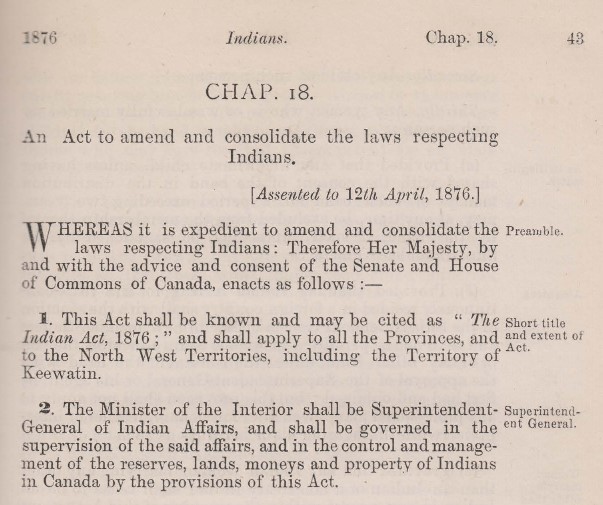
Syllabus 2024
The Canadian government first passed the consolidated Indian Act 1876 as the principal statute through which it governs First Nations communities. This seminar course considers how the Indian Act came to be, how it evolved over time, how First Nations attempted to shape it, and how they have been impacted by it. Students will read different iterations of the Indian Act itself, as well as a variety of texts that situate the Indian Act in Canadian history and in the global history of Indigenous dispossession and settler colonialism. Students will take an active part in leading discussions and will do a major research project.
HIS7338 Graduate Seminar on the History of Colonialism and Postcolonialism – Settler Colonialism
HIS7338_Syllabus2019
In the context of world history, settler colonial regimes worked to disenfranchise and dispossess Indigenous populations, replace them with settler populations, and set up institutional and cultural frameworks to justify or hide the ongoing violence of the process. This seminar examines the global phenomenon of settler colonialism from a historical perspective, and in relation to questions of empire, globalization, race, indigeneity, environment, law, class, and gender.
EAS4103 – Seminar in Indigenous Studies – Settler Colonialism and Law
EAS4103_Syllabus2021
This seminar-style course explores a wide range of questions around settler colonialism and law. We will read works on Indigenous legal thought and practice, as well as the roots, context, implementation, and impacts of colonial legal frameworks. Students will read a selection of academic and non-academic writing on these topics, and will engage themselves and each other in the classroom. They will also apply what they are learning in the context of a research project.
EAS2101 – Colonialism and Indigenous Peoples – University of Ottawa, 2024
Syllabus 2024
This course gives students the opportunity to expand and complicate their understanding of colonialism and Indigenous people through lectures, readings, guest speakers, films, and small-group discussions. Students must complete assigned readings in preparation for each class and regularly submit written reading responses.
The course objectives are:
• that students strengthen their knowledge of Indigenous history and settler colonialism
• that students reflect deeply on their own place in the history and future of Indigenous-settler relations
• that students improve their ability to engage respectfully and helpfully with Indigenous communities and work toward positive change in their own communities
• that students develop an intellectual framework that allows them to recognize and respond appropriately to different types of colonialism
 Daniel Rück